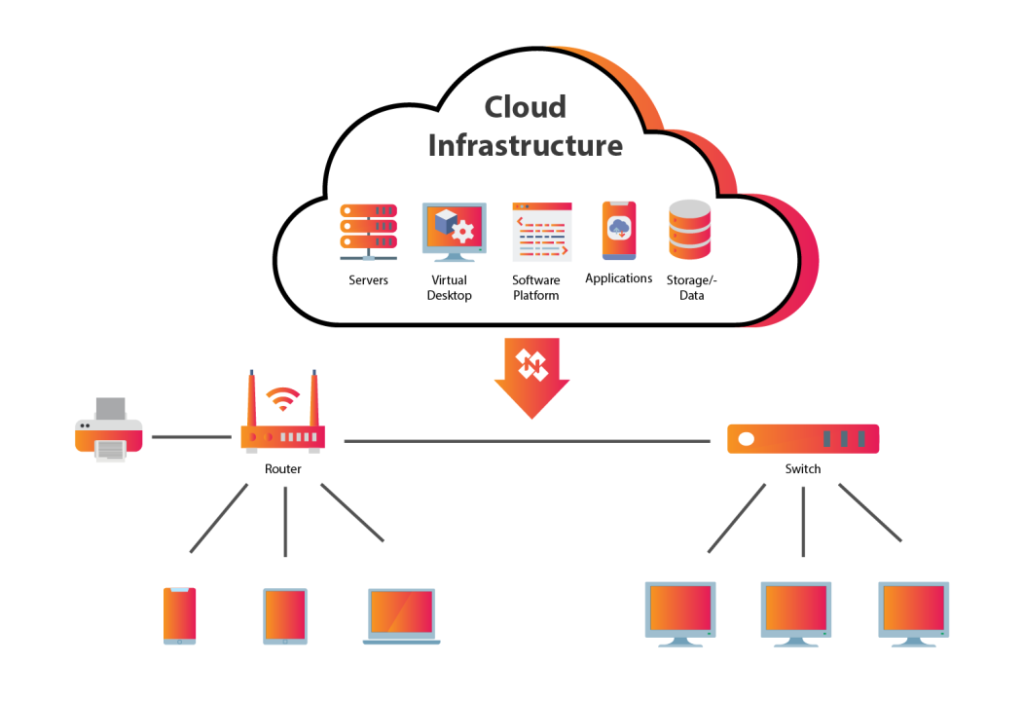
A thorough plan must be followed when choosing the finest cloud-based infrastructure for your SME’s in order to guarantee a seamless, economical, and business-oriented shift. The procedure necessitates a careful approach to preparation, implementation, and continuous optimization. This is a brief guide to help you through this complicated decision-making process. It is compiled from industry best practices.
Define Your Cloud Migration Strategy
A successful cloud migration starts with a well-defined migration strategy. It serves as a roadmap, assisting your company in navigating the challenges of transferring data and applications to a new location. The deployment type and the 7 Rs framework are the two main variables that affect this method.
Deployment Models: Choosing the Right Cloud Landscape
Choosing a deployment model that fits your company’s goals and technology capabilities is the first step. The three primary possibilities are broken down as follows:
- Single-Cloud: With this method, everything of your IT infrastructure will be moved to the platform of a single cloud provider. With centralised management and possible cost savings via vendor discounts, it provides a simpler experience. It does, however, also bind you to a certain provider, which may reduce your flexibility and options down the road.
- Multi-Cloud: In this case, your data and apps are distributed among several cloud service providers. This method encourages more adaptability, enabling you to take use of the advantages of various suppliers for particular requirements. It also lessens dependency on a single supplier, minimising the risk of vendor lock-in and service interruptions. Nevertheless, overseeing several cloud environments might be more difficult and call for powerful orchestration tools.
- Hybrid Cloud: In this arrangement, one or more public clouds are combined with on-premises infrastructure. It provides a compromise between cloud computing’s scalability and affordability and on-premises systems’ control and security. This strategy works best for businesses with compliance requirements that need on-site data storage or for those with old systems that can’t be easily moved to the cloud.
When choosing a deployment methodology, carefully consider your company’s demands regarding future scalability, security requirements, budget, and current infrastructure.
The 7Rs: A Framework for Tailoring Your Migration Strategy
Following the selection of your deployment model, the 7 Rs framework offers an organised method for classifying your data and apps according to the best migration plan. Every “R” stands for a distinct action:
- Retain: Not every data and application has to move to the cloud. Certain resources may need to be kept on-site due to security risks or regulatory restrictions. This “R” serves as a gentle reminder to consider each element’s migration needs carefully.
- Retire: Determine which applications are out-of-date, underutilised, or do not add value, then decommission them. You have the opportunity to simplify your IT environment and get rid of extra clutter by moving to the cloud.
- Rehost (Lift and Shift): This is the easiest method; it just involves moving your current data and apps to the cloud while making the fewest changes possible. Applications with limited dependence on particular hardware configurations and those that have already been virtualized should find it suitable. It may not fully utilize the cloud’s capabilities for scalability and performance optimization, despite being quick and affordable.
- Relocate (Hypervisor-Level Lift and Shift): This also entails migrating the hypervisor and the full virtual machine environment to the cloud, much as Rehost. Even if it’s quicker than moving individual servers, cloud-native features could not be completely utilized.
- Repurchase: Think about switching to cloud-based Software-as-a-Service (SaaS) providers in place of on-premises licenses. This may result in lower costs, automatic upgrades, and simpler administration.
- Replatform (Lift, Tinker, and Shift): With this method, the application is moved to the cloud and modified to take advantage of cloud-native functionalities like elastic storage and autoscaling. Compared to rehosting, it provides better performance and scalability while maintaining ease of migration.
- Refactor (Re-architect): This is the trickiest method since it requires a total rework of the application architecture in order to take full advantage of the cloud. Applications that are extremely complicated or have major performance constraints may require this. It does, however, take a lot of time and development work.
You may design a customised migration plan that optimises cost, reduces downtime, and maximises the advantages of your cloud adoption journey by assessing your applications and data using the 7 Rs. Recall that there is no one-size-fits-all method. The best approach will be a special blend of these Rs that is tailored to your particular need.
Establish a Migration Architect
For your cloud migration to be successful, a migration architect’s job is essential. This person is in charge of organising and carrying out the strategy, making sure that tactical and strategic choices support your goals. They are in charge of figuring out what has to be refactored, creating data migration plans, and setting migration priorities.
Choose Your Level of Cloud Integration
Choose between integrating the cloud in a shallow or deep way. “Lift-and-shift,” or shallow integration, is transferring your apps to the cloud with little to no modifications made to them. Deep integration, on the other hand, may provide greater advantages since it changes apps to take advantage of cloud-native capabilities like serverless computing and auto-scaling.
Evaluate Major Cloud Providers
When assessing cloud service providers, take into account aspects other than price. Examine the exact services that each provider offers, such as networking features, computing services, storage options, and security capabilities. Large suppliers with a broad range of services catered to various demands include AWS, Azure, Google Cloud Platform, and IBM. In order to make the migration and operation of your infrastructure in the cloud easier for SMEs, it’s also critical to evaluate the community resources, support services, and convenience of use that are offered.
Conduct a Cost-Benefit Analysis
It is crucial to examine the cost effects of switching to various cloud providers. Take into account not just the initial and continuing expenses, but also the possible savings from fewer maintenance requirements for IT infrastructure, more scalability, and improved operational efficiency. Cloud service providers offer calculators and tools that might aid in more precise cost estimation.
Prioritize Security and Compliance
Verify that the cloud provider you have selected complies with the legal and security requirements specific to your sector. This includes robust audit and monitoring capabilities, regulatory certifications, and data protection procedures.
Plan for Scalability and Flexibility
Think about how your selected cloud solution will grow with your company. One of the main advantages of cloud computing is the ability to simply scale resources up or down based on demand; your provider should provide simple scaling techniques.
Review and Continuous Optimization
Following the move, keep an eye on and improve your cloud environment to make sure it effectively serves your business’s demands. This covers expense control, performance tracking, and recurring evaluations to make the most of the newest features and services your cloud provider has to offer.
XR Studios providing Cloud Services
Struggling to find the right cloud service provider for your small or medium-sized business? Look no further than XR Studios! Known for its reliability and innovative solutions, XR Studios is a top choice for SMEs seeking a trusted partner in the cloud. With their wide range of services, XR Studios can help your business thrive in today’s digital landscape.
Conclusion
Making the best cloud provider choice for your SME’s infrastructure migration is a strategic choice that will affect many aspects of your company’s operations. You may make a decision that improves your company’s agility, efficiency, and growth potential by taking an organized approach, which includes defining your strategy, evaluating your needs, and thoroughly comparing providers. To assist your company’s long-term success in the digital sphere, keep in mind that the purpose is to locate a cloud solution that fits your business objectives, technical requirements, and budgetary limits.