Augmented reality is changing how consumers buy products and services online, and companies are using innovative techniques to provide customers a satisfying AR experience. With the use of cutting-edge technology, brands are providing online shoppers with greater options to test before they purchase. Examples of these opportunities include virtual try-on products and interactive 3D models on eCommerce websites. Since more and more people are shopping online, extended reality in e-commerce—which was already gaining traction before the pandemic—has become much more important. Brands that deploy augmented reality get higher conversion rates, higher average order values, and fewer returns.
How AR, VR, and 3D models are helping online shopping?
A 2021 study by Deloitte Digital found that more people are using augmented reality (AR) for shopping. About 100 million people shop using AR, and over 1.5 billion use it regularly. This increased during the pandemic and is expected to continue growing, with an estimated 4.3 billion people using AR by 2025.
In eCommerce, AR has proven useful. Customers can use it to see how a product looks on them or in their homes. For example, a shoe company can let customers try on new sneakers from anywhere using a smartphone. AR is also helpful for furniture shopping, allowing customers to see how a piece would fit in different rooms.
Your eCommerce site can provide 3D views of products using optimized models. This may include showing products from various angles or zooming in on specific features. Customers can also see different product variations, like various colors. AR is beneficial for outdoor equipment, luggage, and other items where knowing the size is crucial for making a purchase. Brands using AR provide an enhanced shopping experience, with a 94% higher conversion rate when customers engage with products through virtual reality, according to eCommerce platform data.
What factors are involved in a great AR and VR shopping experience?
To give customers a great AR shopping experience, you need the right technology. The products seen in AR must be digital, and one way to do this is by using product pictures to create 3D models. A skilled 3D modeling expert can take your photos and other important details, like product dimensions, to make a 3D model for AR viewing. Another option is to use photogrammetry, where a modeling provider scans a sample product, either on-site for large items or by mailing in smaller ones.
Once you have a 3D product model compatible with AR, a 3D online viewer can display it in a computer-generated environment. Customers can use their smartphones or tablets to see a digital version of your products in their actual surroundings.
For this technology to work well, you need an augmented reality system with the following features:
- 3D assets that load quickly so customers don’t have to wait.
- High-quality images that truly represent your product’s features.
- Accurate representation of your product’s size through a true-to-size display.
- The ability to interact with the object, view it from all sides, and zoom in.
- Compatibility with any device’s browser, without requiring extra apps or plug-ins, so you include all potential customers, no matter their browser or app.
Who uses reality-based shopping?
Various industries, including consumer goods, home improvement, and beauty and fashion, have adopted augmented reality.
In the fashion and beauty sector, businesses like Nike use AR to improve customer experiences. Nike’s app, for example, helps customers find their actual foot size using smartphone cameras, reducing return rates. Warby Parker lets clients virtually try on glasses with their pictures, and Sephora uses facial recognition for virtual makeup testing.
Furniture is another product category benefiting from augmented reality shopping. Customers can use apps to take a photo of their homes and get suggestions for matching furniture.
Utilize AR, VR, and 3D model experience to boost your sales
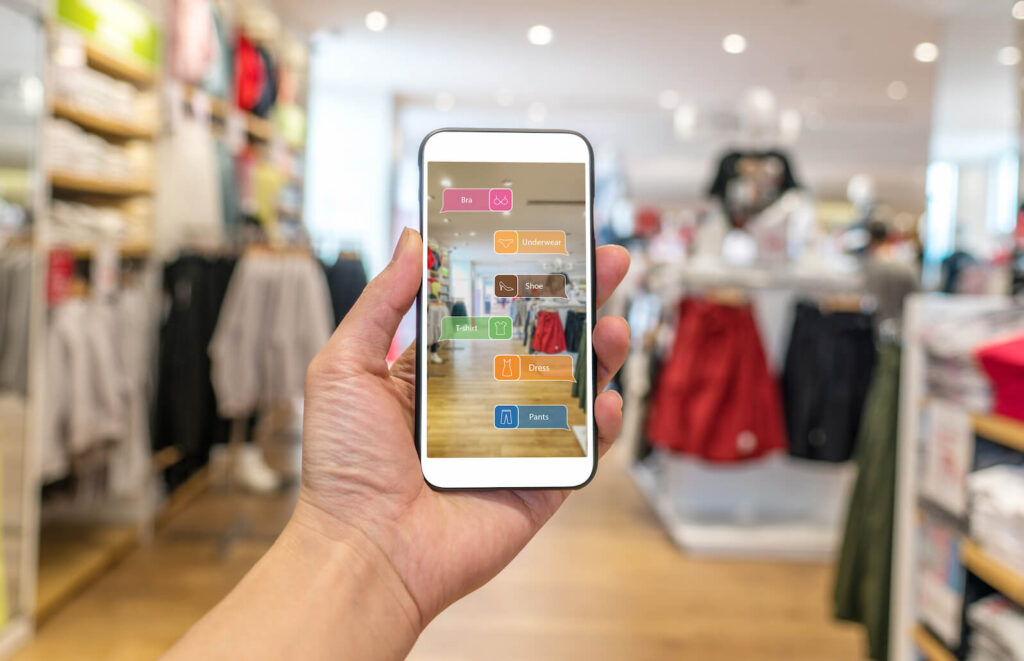
Since the pandemic, more people are getting into augmented reality (AR) shopping, and it’s becoming even more important. Retailers use AR to let customers see things digitally before buying and check out what the experience would be like. Brands using AR apps see better conversion rates, larger orders, and fewer returns.
To make AR shopping work well, the technology behind it needs to be top-notch. It should load things quickly, show high-quality images, be accurate in size, allow zooming, and work on different browsers. For tasks like making 3D models, online viewing, and digital showrooms, you need platforms that meet these requirements.
If you want the best 3D technology for an amazing AR experience, XR Studios is here to help meet those needs.