Virtual reality (VR) and augmented reality (AR) have great potential for the future of gaming, marketing, online shopping, education, and more. These technologies provide better experiences by blending virtual and real-world elements with improved 3-D images. While it’s easy to mix them up, they have important differences. In this article, we’ll talk about the advantages and disadvantages of virtual reality vs. augmented reality.
What is Augmented reality?
Augmented reality (AR) mixes real and virtual things together. It works on computers and mobile devices, and its special feature is putting digital things into the real world.
So, how does augmented reality work?
AR shows different things in the real world, unlike virtual reality (VR). Key things in making this work are computer vision, depth tracking, and mapping. Cameras gather real-time data and process it quickly. This lets users see digital things whenever they want.
To use AR effectively, you need special equipment. Smart Glasses are commonly used, and they display digital information through special software.
Advantages and disadvantages of augmented reality
There is no disagreement over the superiority of either AR or VR technology. Both technologies have positive and negative aspects. The benefits and drawbacks of augmented reality include the following:
Advantages
- Helps people learn on their own and makes learning stronger.
- Many applications for augmented reality exist, and they are always improving.
- Augmented reality can make things more accurate and efficient.
- You can share knowledge or experiences over long distances using augmented reality.
Disadvantages
- Implementing AR has relatively high expenses.
- There are several devices with poor performance.
- Lack of user privacy is a significant drawback.
- The advent of augmented reality could result in a security breach if security is not prioritized.
Applications of augmented reality
In actuality, augmented reality opens up a myriad of options. It is, therefore, intriguing to both individual users and companies. Certain apps allow you to embed text, photos, or videos.
- The printing and advertising industries already do an excellent job of fading digital material over traditional periodicals.
- With AR technology, users can utilize contemporary translation apps to translate texts into various languages.
- Augmented reality in logistics and construction is a promising technique to improve worker productivity and business operations.
- With augmented reality, communicating with clients, coworkers, or technicians is simple.
What is Virtual Reality
The primary distinction between AR and VR is that VR uses computer simulations. This indicates that a graphic representation of reality or a fictional universe is created.
The user can fully immerse himself in the digital environment using the proper hardware. As a result, there are significant disparities between VR and AR headsets. Sensory components that convert physical movements into a modeled reality are needed for hardware designed for virtual reality.
How virtual reality functions
VR aims to recreate a brand-new reality. The user can see and engage in the digital environment using a VR screen. This calls for two lenses between the user and the screen, this calls for two lenses. They interpret eye movement and adjust each person’s activity to the VR. Therefore, in this instance, complex hardware is required to cut off the user from the outside world.
Advantages and disadvantages of virtual reality
Each technology has advantages and disadvantages. For VR, the same is true.
Advantages
- An interactive setting can promote immersive learning.
- Users can delve far into the virtual world.
- These new opportunities are advantageous for the education industry.
Advantages
- In a virtual environment, real-world interaction is impossible.
- It is intriguing to move one’s entire life into the virtual space.
- Learning or practicing in a virtual reality setting is tremendously advantageous; it cannot entirely compete with the actual training.
Applications of virtual reality
In the world of video games, virtual reality is incredibly well-liked. However, VR also has a wide range of other potential uses:
- This technology is employed by the military in flight simulators and battle reenactments.
- Digital training tools aid athletes in sports by analyzing their technique and helping them perform better.
- VR can be utilized in medicine to treat anxiety or post-traumatic stress disorder. The technology also enables medical students to practice surgical procedures.
Comparison of augmented and virtual reality
Significant differences exist between AR and VR. But this obvious distinction does not imply that one of the two technologies is superior. Instead, both technologies excel in distinct application domains:
- AR improves the real world, while VR gives a completely virtual experience.
- AR is 25% virtual, but VR is 75%.
- You need a headset for VR, not for AR.
- AR users interact with the real world, while VR users are in a made-up one.
- AR uses more data compared to VR.
- AR aims to enhance both the real and virtual worlds, while VR replaces the real world with a created one, mostly for video games.
VR and AR work well together.
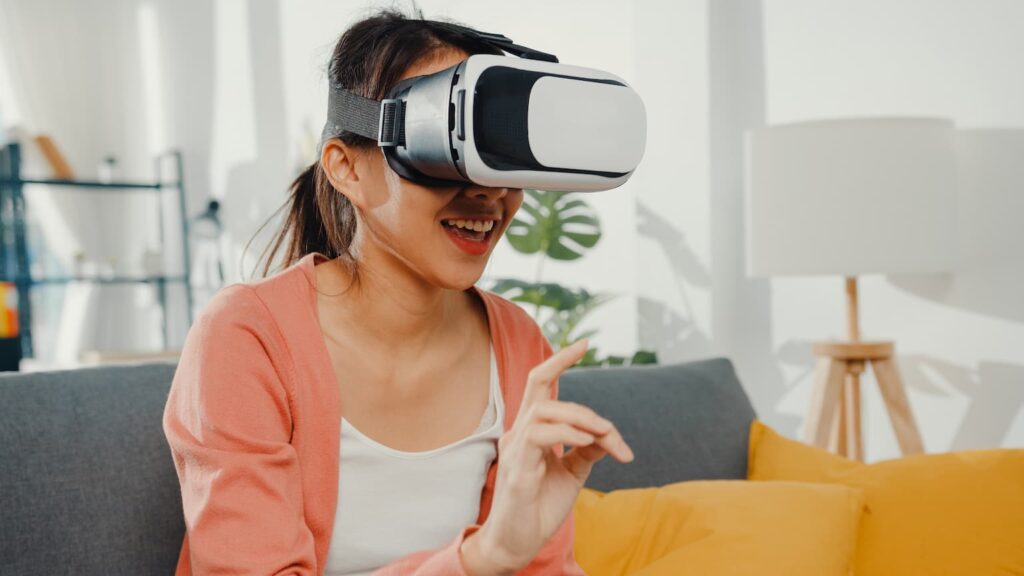
When AR and VR work together, they create a strong and cooperative system. Although they can work on their own, combining them gives users a more enjoyable experience. The goal is to build a make-believe world that allows interaction with the real world.
XR Studios making AR and VR based applications
XR Studios provide services for augmented and virtual reality applications, which can elevate your business to a whole new level.